Introduction
With the rising demand for peanut butter in food processing, bakery production, catering services and retail markets, manufacturers are placing greater emphasis on efficient and stable production solutions. Traditional peanut butter processing requires substantial manual labor, frequent material transfer, and stringent controls over production procedures.
An automated peanut butter production line integrates multiple processing stages including peanut cleaning, roasting & cooling, peeling, grinding, mixing, cooling, degassing, storage and filling into one harmoniously operating system. With automated production, enterprises can boost overall production efficiency while maintaining consistent product quality.
This article explains how automated peanut butter production lines enhance production capacity and why they are suitable for modern peanut butter factories.
1. Continuous Processing to Boost Production Speed
One of the most prominent advantages of an automated peanut butter production line is its capability for continuous processing.
In conventional production workflows, operators have to manually transfer materials between separate machines, which creates waiting periods and production downtime. In contrast, the automated production line connects all core equipment via elevators, conveyor belts, hoppers and control systems, enabling uninterrupted material flow.
Peanuts go through these processing stages in sequence:
Since all stages are interconnected, the whole production line minimizes unnecessary stops and lifts the overall processing speed.
2. Reduced Labor Requirement
Traditional processing requires workers to operate individual machines, transfer materials, monitor production and adjust processing parameters. This not only raises labor costs but also may cause inconsistent production outcomes due to variations in manual operation. An automated peanut butter production line can drastically cut down the number of workers required.
Operators are mainly responsible for:
In this way, manufacturers can produce more high-quality peanut butter with fewer employees, which is especially suitable for medium and large-scale peanut butter processing plants.
3. More Consistent Roasting Results
Roasting is a critical stage in peanut butter production. Roasting temperature and duration directly affect:
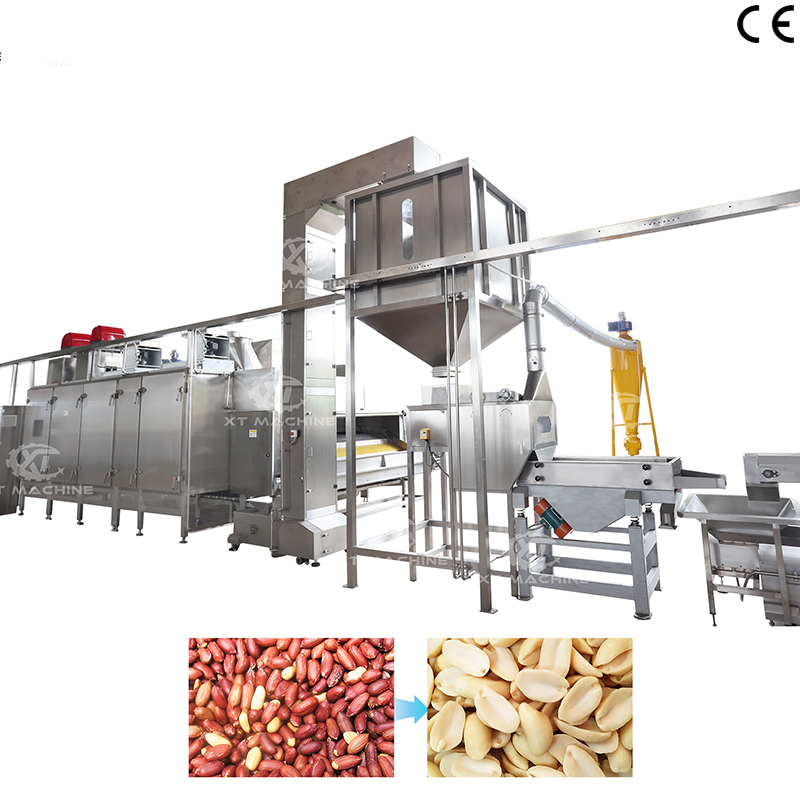
Automated roasting equipment delivers precise temperature control, adjustable conveying speed and uniform heating. Compared with manual roasting, industrial roasters provide more consistent processing results across different batches.
For mass production, continuous roasting ovens maintain stable roasting conditions while handling peanuts continuously, helping to avoid under-roasting, over-roasting or uneven heating.
4. Improved Peanut Peeling Efficiency
After roasting and cooling, peanuts normally need their red skins removed. Residual peanut skins may impair the appearance, texture and color of peanut butter.
The peanut peeling & half-kernel separating machine continuously removes peanut skins, separates skins from peanut kernels and removes germ, so as to improve processing efficiency and reduce manual peeling work. Automatic peeling equipment also maintains a stable peeling rate, which is particularly vital for factories that produce large volumes of peanut butter daily.
5. Optimized Grinding Process
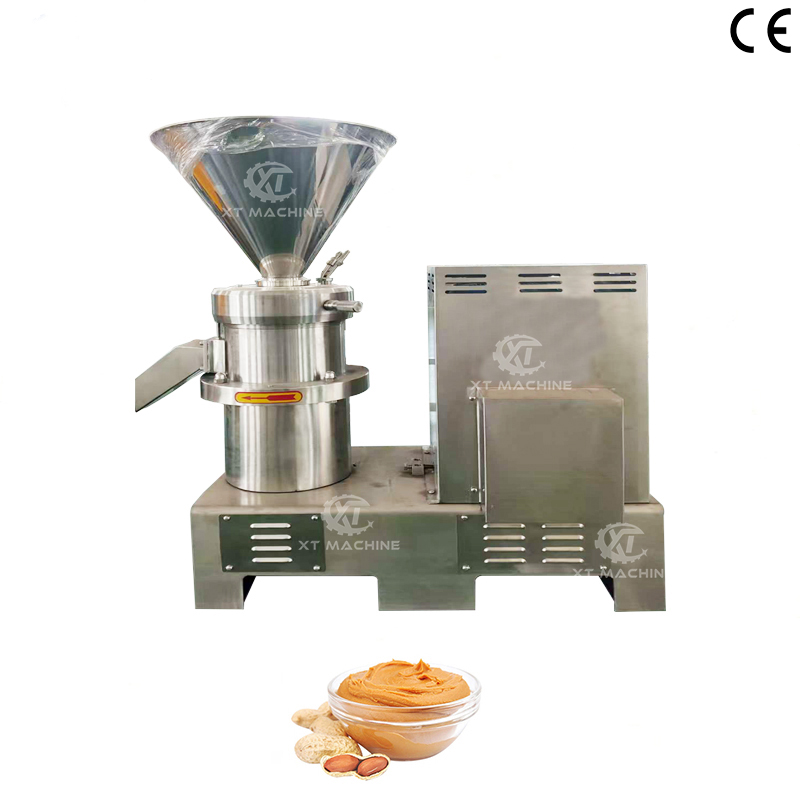
The grinding stage determines the smoothness and mouthfeel of peanut butter. An automated peanut butter production line can be equipped with high-efficiency peanut butter grinders according to the target product texture.
The grinding system can be adjusted to produce:
Smooth-style peanut butter
Crunchy-style peanut butter
Other nut butter products
The automatic feeding and grinding system helps maintain a stable material flow, prevents equipment overload, reduces production downtime and improves grinding efficiency.
For manufacturers producing various nut butter products, the same production line can also process:
Cashew butter
Almond butter
Hazelnut butter
Pistachio butter
Sesame paste
Mixed nut butter
6. Reduced Material Transfer and Product Loss
In manually operated factories, materials need to be transferred multiple times between different machines. Each transfer increases the risks of:
Material loss
Material spillage
Product contamination
Uneven feeding
Production delays
Automated peanut butter production lines adopt enclosed conveyors, hoppers, pumps and storage tanks to cut down unnecessary material handling. This not only boosts production efficiency but also improves sanitary conditions and reduces raw material waste.
7. Improved Production Precision and Process Control
Automated systems enable more precise control over key production parameters. Depending on the line configuration, the control system can monitor and adjust:
Centralized control allows operators to detect issues faster and adjust production processes in a timely manner. It also ensures every batch is manufactured in accordance with unified operational standards.
8. Consistent Product Quality
Consistent product quality is critical for peanut butter manufacturers. Consumers expect consistency in flavor, texture, color and package weight with every purchase.
By precisely controlling each production stage, the automated peanut butter production line helps maintain stable product quality.
For example:
Consistent roasting improves flavor profiles
Efficient peeling enhances product appearance
Stable grinding ensures uniform mouthfeel
Precise mixing guarantees homogeneous formula blending
Automatic filling boosts accuracy of package weights
This is especially important for manufacturers supplying supermarkets, food brands, restaurants, bakeries and international distributors.
9. Improved Factory Workflow
A well-designed automated peanut butter production line optimizes the overall factory layout. Machinery can be arranged in line with the actual production sequence to cut unnecessary movement of personnel and materials. A rational production layout generally consists of:
Raw material receiving area
Cleaning and pre-treatment area
Roasting and cooling area
Peeling and sorting area
Grinding and mixing area
Storage area
Filling and packaging area
Finished product storage area
A streamlined workflow boosts production efficiency and simplifies factory management.
10. Ideal for Large-Scale Production
Manual or semi-automatic machines may suffice for small workshops. However, as output grows, manual operations become increasingly difficult to manage.
Automated peanut butter production lines are suitable for manufacturers requiring:
Higher production capacity
Stable daily output
Lower labor costs
Consistent product quality
Shorter processing time
More efficient production management
Convenient future expansion
Production capacity can be customized according to client requirements, such as 300 kg/h, 500 kg/h, 1000 kg/h or higher. The final throughput depends on raw material conditions, product formulas, grinding requirements, equipment configuration and factory site conditions.
12. Reduced Long-Term Operating Costs
Although the upfront investment of an automated peanut butter production line is normally higher than purchasing individual basic machines, it reduces operating expenses in the long run.
Key cost-saving benefits include:
Lower labor requirements
Less material waste
Fewer production stoppages
Optimized energy management
Consistent product quality
Increased daily output
Easy maintenance and management
When evaluating equipment investment, manufacturers should consider not only the purchase price, but also long-term operating costs and expected production efficiency.
13. Convenient Monitoring and Maintenance
Modern automated peanut butter production lines are generally equipped with electric control cabinets, touch screens, sensors and alarm systems.
Operators can monitor the running status of all equipment and detect faults in a timely manner. The system can display various real-time statuses:
This helps reduce production downtime and improve the efficiency of daily maintenance.
Conclusion
By integrating multiple processing procedures, reducing manual operation, optimizing material circulation and realizing precise process control, the automated peanut butter production line effectively improves overall production efficiency.
From roasting and peeling to grinding, mixing, storage and filling, automated production enables enterprises to achieve higher output, more stable product quality, lower operating costs and more efficient factory management.
For enterprises planning to build or upgrade peanut butter factories, investing in a well-designed automated peanut butter processing production line is an effective way to enhance long-term market competitiveness.
Get a Quote
If you are looking for a reliable automated peanut butter production line or customized peanut butter processing solutions, feel free to contact us for detailed information and professional quotation.
Company: Yantai XT Machinery Manufacturing Co., Ltd.
Website: xtpeanutmachine.com
Email: sales002@xtpeanutmachine.com
WhatsApp: +86 13780905717