Peanut Processing Machinery WhatsApp: 8613954503673 E-mail: sales@xtpeanutmachine.com sales001@xtpeanutmachine.com
Peanut Processing Machinery WhatsApp: 8613954503673 E-mail: sales@xtpeanutmachine.com sales001@xtpeanutmachine.com
Sep. 04, 2026
A commercial peanut butter production line consists of multiple pieces of equipment working in synergy to process raw peanuts into finished peanut butter.
For food manufacturers planning to build a peanut butter processing plant, selecting suitable machinery is a key step in project construction. Equipment configuration directly impacts production capacity, processing efficiency, product consistency and the automation level of the entire factory.
A typical peanut butter processing line generally includes peanut cleaning equipment, roasting machine, blanching machine, sorting equipment, peanut butter grinder, mixing tanks, cooling machine, storage tanks and filling machine.
Depending on production requirements, auxiliary equipment such as elevators, transfer pumps, vacuum deaeration tanks, capping machines and labeling machines can also be integrated into the production line.
Peanut Butter Production Line Process Flow
For instance, ultra-fine grinding procedures are adopted for producing smooth-style peanut butter. In contrast, chunk-style peanut butter requires specialized processing methods to retain intact peanut particles and achieve a granular texture.
Main Equipment for a Peanut Butter Processing Line
The first step in peanut processing is raw material cleaning.
Raw peanuts may contain dust, stones, plant residues and other impurities. The destoner removes these contaminants before peanuts go into the roasting process.Thorough impurity cleaning helps improve peanut quality and protects downstream processing equipment.For large processing plants, peanut cleaning equipment can be matched with elevators, conveyors and other material handling machines to build a continuous production workflow.
The peanut roaster is one of the core machines in a peanut butter production line.
Roasting develops the unique aroma and flavor of peanuts and prepares them for subsequent processing.Roasting temperature and duration can be adjusted according to raw peanut characteristics and end-product requirements.
Once roasted, peanuts move to the cooling section before entering blanching and grinding stages.Cooling also helps create more stable processing conditions for the next procedure.In continuous production lines, the roasting section can be directly connected to the cooling section to reduce manual handling.
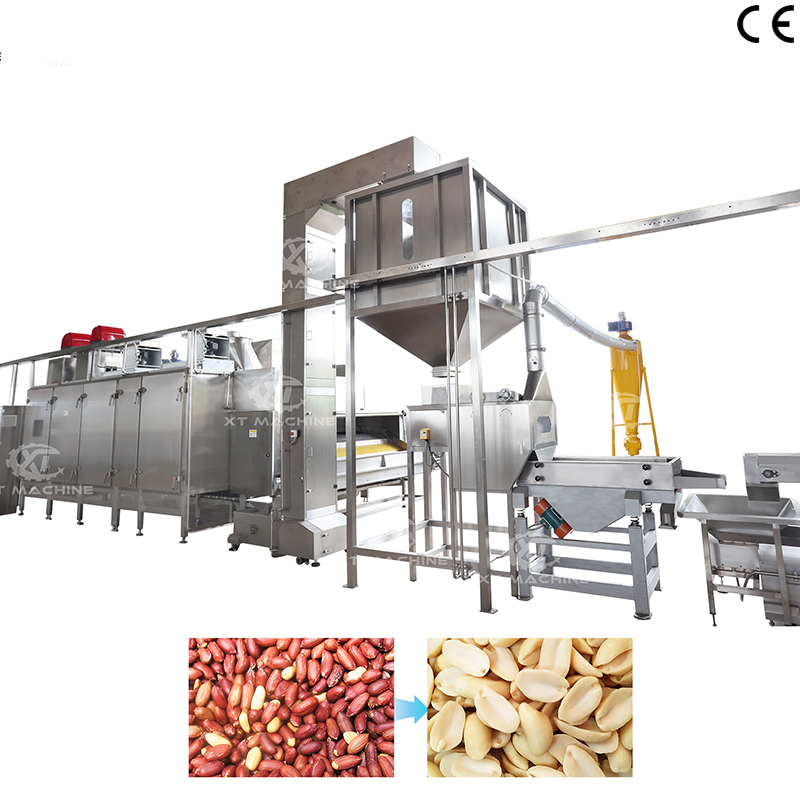
The peanut blancher is mainly used to remove the red skin from roasted peanuts.
Blanching is an essential process for making light-colored, smooth peanut butter. Removing the red skin improves both the appearance and taste of finished peanut butter.Blanched peanuts are then conveyed to color sorting or manual inspection stations.
After blanching, peanuts go through sorting or manual selection.
Before peanuts enter the grinding process, substandard kernels, residual peanut skins and other foreign materials are removed.Manufacturers can choose manual picking belts or automated sorting machines based on different production capacities.
This stage ensures the raw material fed into the grinder is more uniform and consistent.
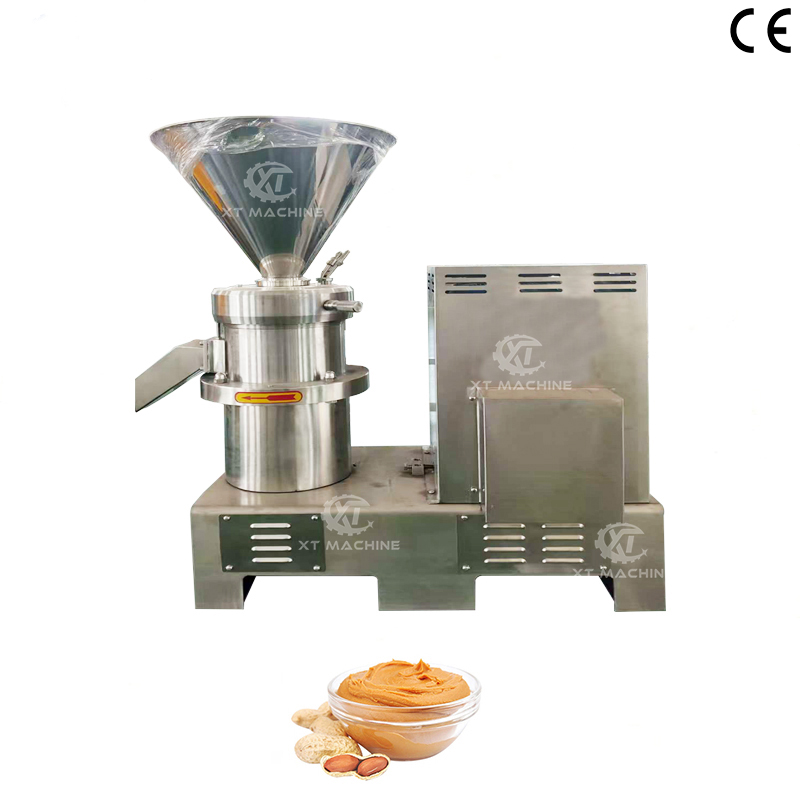
The peanut butter grinder is the core machine that processes prepared peanut kernels into peanut butter.
During grinding, peanuts are subjected to mechanical shearing and grinding forces. The particle size gradually decreases to form a smooth peanut butter paste.The grinding system can be configured according to the texture requirements of the final product.
For example:
Smooth-style peanut butter requires fine and uniform grinding.
Chunk-style peanut butter needs to retain peanut particles of a certain size.
Different types of nut butters may require different grinding parameters.
For commercial production, select a suitable grinder based on required output, product characteristics and target fineness. When an extra smooth and uniform product is needed, some industrial production lines adopt multi-stage grinding processes.
After grinding, other ingredients can be added according to the product formula. Common additives include salt, sugar, vegetable oil and other formula components.
The peanut butter mixer helps these ingredients disperse evenly throughout the peanut butter. The mixing system delivers stable stirring performance as required by line design, and can be combined with cooling or other processing functions.The capacity of the mixing tank should match the output of the grinding section to maintain balanced operation of the whole production line.
Stainless steel storage tanks are used to temporarily hold peanut butter after grinding and mixing, providing buffer storage before filling.Tank capacity should match the production capacity and filling speed. Large-scale production lines can be equipped with multiple storage tanks to increase buffer volume and improve production continuity.
Product-contact parts of the equipment are generally made of food-grade stainless steel, which is durable, hygienic and easy to clean.
Some peanut butter production lines include a vacuum deaeration stage.
Air may get incorporated into peanut butter during grinding and mixing. Vacuum treatment removes bubbles and trapped air from the paste prior to filling.The need for a vacuum deaeration system depends on product formula, processing technology and packaging requirements.
Therefore, vacuum deaeration equipment should be considered as part of the overall line design; it is not mandatory for every peanut butter factory.
Filling is the final major stage in peanut butter processing.
The peanut butter filling machine dispenses finished peanut butter into glass jars, plastic bottles, containers or other packages.Since peanut butter is a high-viscosity product, filling equipment shall be selected according to product viscosity, container specifications and filling accuracy requirements.
Semi-automatic fillers suit small and medium-scale production, while automatic filling and packaging systems are applied in large production lines. Automated systems can be further integrated with capping machines, sealing machines and labeling machines.
There is no standard equipment configuration suitable for all peanut butter processing plants.Before purchasing machinery, manufacturers should focus on the following aspects.
Production capacity is one of the most critical factors for equipment selection. Small food processors may require compact or semi-automatic production lines, while large food factories need continuous automatic production systems.
The processing capacity of each machine shall be reasonably matched to prevent any single processing stage from becoming a bottleneck for the whole line.
Different products require different processing setups. Plants producing smooth-style peanut butter usually prioritize fine grinding and homogenization results. Manufacturers making chunk-style peanut butter need to retain properly sized peanut particles.If the plant plans to produce other nut butters such as sesame paste, cashew butter, almond butter, hazelnut butter or pistachio butter, a multi-functional nut butter processing system can also be considered.
Peanut butter production lines can be designed with varying automation levels according to customer requirements.
Semi-automatic systems may require operators to transfer materials or control individual processing sections separately. Fully automatic production lines connect multiple machines via conveyors, elevators and automatic control systems to cut manual labor and improve production continuity.
Available space in the factory should be fully considered before equipment selection.
The production line layout shall ensure a logical and smooth material flow, starting from raw peanut feeding all the way to finished product packaging. Professional machinery manufacturers can design equipment layouts based on customers’workshop dimensions and production requirements.
Why Choose a Complete Peanut Butter Processing Line?
For small-scale processors, buying standalone machines can meet basic production needs. However, for commercial production, a complete production line delivers better connection between different processing stages.
A well-designed production line helps enterprises to:
Reduce manual material handling
Boost production efficiency
Maintain a more stable production process
Minimize production bottlenecks
Improve equipment utilization rate
Support future capacity expansion
Simplify production management
The final equipment configuration shall still be determined according to the customer's specific production requirements.
Get Quotation for Peanut Butter Processing Equipment
If you are looking for peanut butter production lines, peanut butter grinders, peanut roasters or other peanut processing machinery, please feel free to contact us.
Company Name: Yantai XT Machinery Manufacturing Co., Ltd.
WhatsApp: +86 18906425332
Website: xtpeanutmachine.com
Email: sales002@xtpeanutmachine.com
Please provide us with your target production capacity, peanut butter type and workshop requirements. Our technical team will recommend suitable equipment according to your demands and offer customized peanut butter processing solutions.
Navigation
WhatsApp: 8613954503673
Tel: +86 13954503673
E-mail: sales@xtpeanutmachine.com
Add: No.8, Jinshajiang Road, Yantai ETDZ, China
E-mail: sales001@xtpeanutmachine.com
Follow Us